

List My Business Free: A Complete Guide for Owners
 General
Most owners decide to list my business free, open a registration form, and abandon it halfway because they do not have their details to hand. The publishing part takes minutes. The preparation is what people underestimate. This guide covers what to gather first, how to complete each field properly, and what a free profile does and does not include.
Key Takeaways
- Preparation takes longer than publishing. Gather your details before opening any form.
- Free profiles are genuinely free on most directories. Paid tiers add promotion, not access.
- The optional fields are where the advantage sits, because most businesses skip them.
- A profile left unmaintained stops working within a year.
What to Prepare Before You Open Any Form
Open a blank document before you open a registration page. Write your business name exactly as it should appear everywhere. Add your full address, phone number, website, opening hours and the category that best describes your main work.
This document is not busywork. It becomes the reference you compare every future profile against. Without it you end up typing slightly different details into each platform, which is precisely what causes the visibility problems described in the complete guide to business profiles.
Gather five or six photographs at the same time. Exterior, interior, your work, your team and one detail that distinguishes you. Having them ready means you finish the profile in one sitting rather than leaving it half complete.
Include the details that are easy to get slightly wrong. Unit or floor numbers. The landmark you mention when giving directions. The area spelling used officially rather than colloquially. Settle each one now, because you will be asked repeatedly and consistency only holds if the answer never varies.
Note your legal entity name separately from your trading name if they differ. Decide which one appears publicly. Mixing the two across platforms creates records that look like two businesses, and untangling that later is far harder than deciding now.
What Free Actually Includes
Owners are reasonably suspicious of anything free. On most reputable directories the free tier includes full profile creation, all standard fields, photographs and the ability to receive reviews. Paid tiers usually add promotion and placement rather than access.
The distinction matters. If a platform charges simply to appear, its free listings are unlikely to carry much weight anyway. Look for directories where a complete profile costs nothing and payment buys visibility on top.
There is a useful test for any directory asking for payment. Ask what the free tier actually prevents. If the answer is basic presence, be cautious, because a directory whose free entries carry no weight has little to sell. If the answer is promotion above an already complete profile, that is a normal and reasonable model.
Check the directory itself before committing either money or time. Search for it and see whether its pages appear in results. Look at whether existing profiles carry genuine detail or read as thin placeholders. A platform nobody finds cannot pass any benefit to you, whatever it charges.
Completing the Form Without Leaving Gaps
Work through every field, including the ones marked optional. Optional is a description of the form, not of the value. Most businesses stop at the mandatory fields, which is exactly why completing the rest is such a cheap advantage.
Work through the form in order rather than skipping ahead to the interesting parts. Forms are usually sequenced so that later fields depend on earlier ones, and jumping around is how people end up with a category that does not match the service list beneath it.
Save as you go where the platform allows it. Losing twenty minutes of careful entry to a timed out session is the most common reason a registration gets abandoned and never resumed.
Identity and contact
Copy these directly from your reference document. Do not retype them from memory, because small variations in abbreviation or spacing create the inconsistencies that cost visibility later.
Category and service area
Choose the narrowest category that honestly describes your main work. List every area you genuinely serve. A business covering several towns loses searches from most of its market if it lists only one.
Writing a Description People Actually Read
Your description has two audiences. A customer deciding whether to call, and a system deciding which searches you match. Both are served by plain, specific language about what you do and who you do it for.
Avoid marketing abstractions. Phrases like quality service and customer focused appear on thousands of profiles and distinguish none of them. Name the service, the sector and the area. Compare how a technology company describes its specialism against a generic corporate paragraph. The specific version tells you immediately whether to get in touch.
Google's guidance on writing genuinely helpful content applies directly. Write for the person trying to decide, not for a keyword target.
Lead with the specific rather than the impressive. A first sentence naming what you do, who for and where beats an opening line about your commitment to excellence. The reader is deciding whether you are relevant, and they decide fast.
Include the terms customers actually use. If people ring asking for a particular service by a common name, use that name rather than the formal industry term. The words in your enquiries are better source material than the words on your brochure.
Say what you do not do where it saves time. A firm that handles commercial work but not residential should state it. Ruling out the wrong enquiries is as valuable as attracting the right ones, and customers appreciate the clarity.
Submitting and What Happens Next
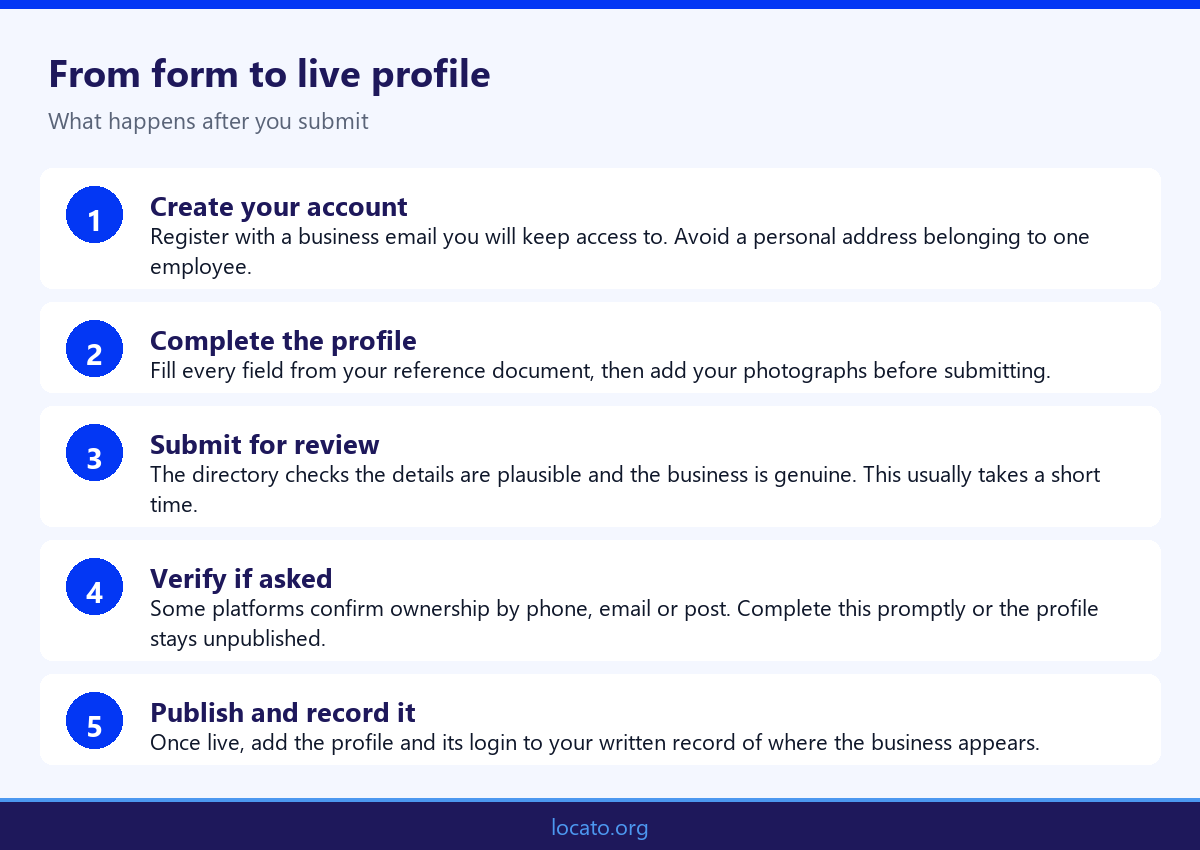
Most directories review new submissions before publishing. This protects the quality of the directory and, by extension, the value of your profile within it. Expect a short wait rather than instant publication.
Use an email address the business controls rather than one belonging to an individual. Profiles registered to a personal account become genuinely difficult to recover when that person leaves, and recovery often requires proving ownership from scratch.
Complete verification promptly when prompted. An unverified profile may remain unpublished or stay outside your control, and the verification window sometimes expires. Whatever method the platform offers, finish it in the same week you submit.
Keeping the Profile Working After Launch
A profile is not a task you complete. Hours change, numbers get reassigned and photographs date. The businesses that keep appearing are the ones that spend ten minutes a month checking.
Set a recurring reminder. Check your hours, confirm the phone number still reaches you, read any new reviews and reply to them. Replace any image showing a previous location or an old fit out. That short routine protects everything the setup achieved.
Assign the task to one named person. Shared responsibility is how details drift, because everyone assumes someone else is watching. If nobody owns it currently, the Locato team can suggest a simple routine.
The monthly check does not need to be elaborate. Confirm the phone number still reaches you. Check the hours against reality, including any seasonal change. Open the website link. Read and reply to any new reviews. Replace any photograph that no longer reflects the business.
Tie additional checks to events rather than dates alone. A move, a new phone line, a rebrand or a change of ownership should each trigger a full review. These four situations cause most of the inconsistencies that damage visibility, and catching them immediately takes minutes.
Common Reasons a Free Profile Fails to Perform
A free profile rarely fails because it was free. It fails for a small number of recurring reasons, all of which are within your control.
The most common is incompleteness. Mandatory fields filled, optional fields ignored, no photographs and no service list. The profile technically exists and gives neither customers nor platforms enough to work with. The second is a category chosen too broadly, which leaves the business eligible for searches it can never win.
The third is abandonment. Details that were accurate at launch quietly become wrong, and nobody notices because nobody is looking. The fourth is duplication, where a second entry exists and divides reviews between two records.
It is worth being realistic about what a single profile achieves on its own. It will not transform a business overnight, and any directory promising that is overselling. What it does is make you reliably findable by people who are already looking for what you provide, which is a narrower promise and a far more dependable one.
The value compounds because the work is cumulative rather than repeated. A profile completed properly this month is still working next year with only the monthly check to sustain it. Very little else in marketing behaves that way. Advertising stops the moment you stop paying. Social content disappears within days. An accurate profile simply continues.
That durability is also why the preparation matters so much. Details published carelessly propagate outward as other platforms copy them, and correcting that spread takes considerably longer than getting it right at the start. The hour spent on your reference document is not overhead. It is the part that makes everything afterwards cheap.
If you are weighing this against other things competing for your attention, the honest comparison is time rather than money. An hour now and ten minutes a month is the entire commitment. Very few activities available to a small business return as much for as little sustained effort.
Fixing incompleteness
Return to the profile with your reference document and fill every remaining field in one sitting. This is usually under an hour of work and produces the largest single improvement available to most businesses.
Fixing abandonment
Set a recurring monthly reminder and assign it to a named role. The check takes ten minutes. The absence of it is what allows a working profile to quietly stop producing enquiries over the course of a year.
What to Do in the First Ninety Days
The period immediately after publishing shapes how well the profile performs afterwards. A little attention early saves considerable correction later.
In the first week, check how the profile renders on a phone as well as a desktop. Confirm the number dials through and the website link opens the page you intended. Ask two people who do not know the business to read it and tell you what they think you do.
In the first month, focus on reviews. Ask recent satisfied customers directly, because most people are willing and simply never think of it. Reply to everything that arrives. In the second and third months, watch which searches bring people to you and adjust your description to match the language they are actually using. Details on measurement are covered in the complete listings guide.
There is one more reason to treat the standard high. Your profile is increasingly the first thing anyone sees about your business, ahead of your website and well ahead of anything you pay to distribute. A recommendation from a friend, an advert, a van seen in the street: each of them ends with somebody searching your name. What that search returns is what decides whether the impression survives contact.
Treated that way, an hour spent completing the profile properly is not administration. It is the moment most of your prospective customers form their opinion, and it is one of the few such moments you control completely.
What to Do When You Have More Than One Location
Multi location businesses face a set of decisions single site businesses never encounter, and getting them wrong creates problems that are tedious to unpick later.
As a general rule, each location that serves customers independently and has its own address and phone number deserves its own profile. A branch that shares a number with head office and cannot be visited usually does not. The test is whether a customer could meaningfully arrive there or call it directly.
Keep naming consistent across locations. Use the same business name with a location identifier appended in the same format every time. Inconsistent naming across branches makes the group read as unrelated businesses rather than one organisation with several sites.
Assign service areas carefully so branches do not compete with each other for the same searches. Two profiles claiming identical coverage split attention rather than doubling it. Divide the territory sensibly and let each branch own its own area.
Central control, local accuracy
Hold the reference document centrally so every branch uses the same formats, but let each location confirm its own hours and photographs. Head office rarely knows when a branch changed its Saturday timings.
Watch for branch created duplicates
The most common source of duplicate profiles in a multi site business is a manager registering their location independently. A shared record of every profile prevents this entirely.
Turning a Profile Into Actual Enquiries
A complete profile makes you findable. Converting that visibility into contact takes a little more thought, and most of it concerns removing friction.
Make the next step obvious. The action you most want someone to take, whether that is calling, visiting or sending a message, should be the easiest thing to do from your profile. Check that the number dials on a phone and that any link opens the page you intended rather than a generic home page.
Answer the questions customers actually ask before they have to ask them. If people routinely want to know whether you offer home visits, whether you work weekends or which areas you cover, put those answers in the description. Every question you pre empt is a reason someone does not move on to the next profile.
Respond quickly when contact arrives. The advantage of appearing in a local search is that the person usually needs something soon. A reply the following week reaches someone who has already chosen a competitor.
Finally, close the loop by asking satisfied customers for a review. Review flow is one of the strongest signals a profile carries, and it is almost entirely within your control. Most people are willing and simply never think to do it unless asked directly.
Answering the Objections Owners Usually Raise
A few reasonable hesitations come up repeatedly. They deserve straight answers rather than reassurance.
The first is time. Owners assume this is an ongoing commitment they cannot sustain. In practice the work is front loaded. An hour to set up properly, then ten minutes a month. That is less time than most businesses spend on a single social media post, and it keeps working without further input.
The second is scepticism about whether anyone actually uses directories. The honest answer is that customers rarely visit a directory deliberately. They search, and directory pages appear among the results. Your profile works by being found through search rather than by people browsing the platform itself, which is why indexing matters more than the directory's own traffic.
The third is a worry about giving away contact details. Everything on a business profile is information you already publish on your signage, your website and your invoices. You are not exposing anything private. You are making public information easier to find and harder to get wrong.
The fourth is the suspicion that free must have a catch. On a credible platform the catch is simply that promotion costs money while presence does not. That is a normal model. The directories worth avoiding are the ones charging for presence itself, and the test in the section above will identify them quickly.
What if my business is very small
Small businesses benefit most, because accuracy is one of the few areas where budget does not decide the outcome. A sole trader with a complete, maintained profile can appear alongside far larger competitors.
What if I am not technical
Nothing here requires technical skill. The forms are designed for owners, and the hardest part is gathering your own details. If a step genuinely blocks you, most directories offer direct support for new registrations.
A Checklist to Work Through
Use this as the practical summary. Work down it in order and the profile will be complete without further reference to anything above.
Write your standard details in one document, covering name, address, phone, website, hours and category. Decide the public form of your business name and stick to it. Gather five or six photographs in a single session. Register using a business email that will outlast any individual employee.
Complete every field on the form, including the optional ones. Choose the narrowest category that honestly describes your main work, then add secondary categories only for services you genuinely deliver. List every area you realistically serve and no areas you do not. Write a description that names what you do, who for and where, in plain language.
Submit, then complete any verification promptly rather than leaving it. Once live, check the profile on a phone, confirm the number dials and the website link opens correctly. Record the profile and its login in your list of where the business appears.
Then set a monthly reminder and give it to a named role. Ten minutes checking hours, contact details, photographs and reviews is what keeps everything above working. Without that step, a profile that launched perfectly will quietly stop producing results within about a year.
Keeping Perspective on What This Is For
It is easy to lose sight of the purpose somewhere among fields, categories and verification codes. The point of all of it is narrow and worth restating: making it easy for someone who already wants what you sell to find you and contact you without friction.
Every field on the form serves that single aim. The address helps them reach you. The hours stop them arriving when you are closed. The category puts you in front of the right search. The photographs answer whether the place looks right. The description confirms you handle their particular problem. None of it is decoration.
That framing also tells you how to resolve any question the form raises. When you are unsure what to enter, ask which answer helps a genuine customer decide. That question resolves most uncertainty faster than any rule, and it produces profiles that read as written by a person rather than assembled for an algorithm.
It explains the maintenance too. A detail that was helpful last year and is now wrong has turned into an obstacle. Old hours send someone to a closed door. A disconnected number ends the enquiry entirely. Maintenance is not tidiness for its own sake. It is removing obstacles that accumulated while you were busy running the business.
Finally, it sets a realistic standard for when you are finished. You are finished when a stranger could read the profile and know what you do, whether you serve their area, when you are open and how to reach you, without needing to look anywhere else. That is achievable in an hour, and most businesses never reach it.
Conclusion
Publishing a free profile is genuinely quick once your details are gathered. The work that matters is the preparation beforehand and the ten minutes a month afterwards. Get both right and a free profile will keep returning customers for years. When you are ready, you can create your profile on Locato and have it live in a single sitting.
Frequently Asked Questions
Is listing a business really free?

How long does registration take?
What information do I need before starting?
Why do directories review submissions?
What is verification and why is it needed?
Can I edit my profile after publishing?
Should I use a personal email to register?
How many directories should I appear on?
Does a free profile help with search visibility?
What if my business is already listed?