

How Business Local Listings Help Customers Find and Trust You
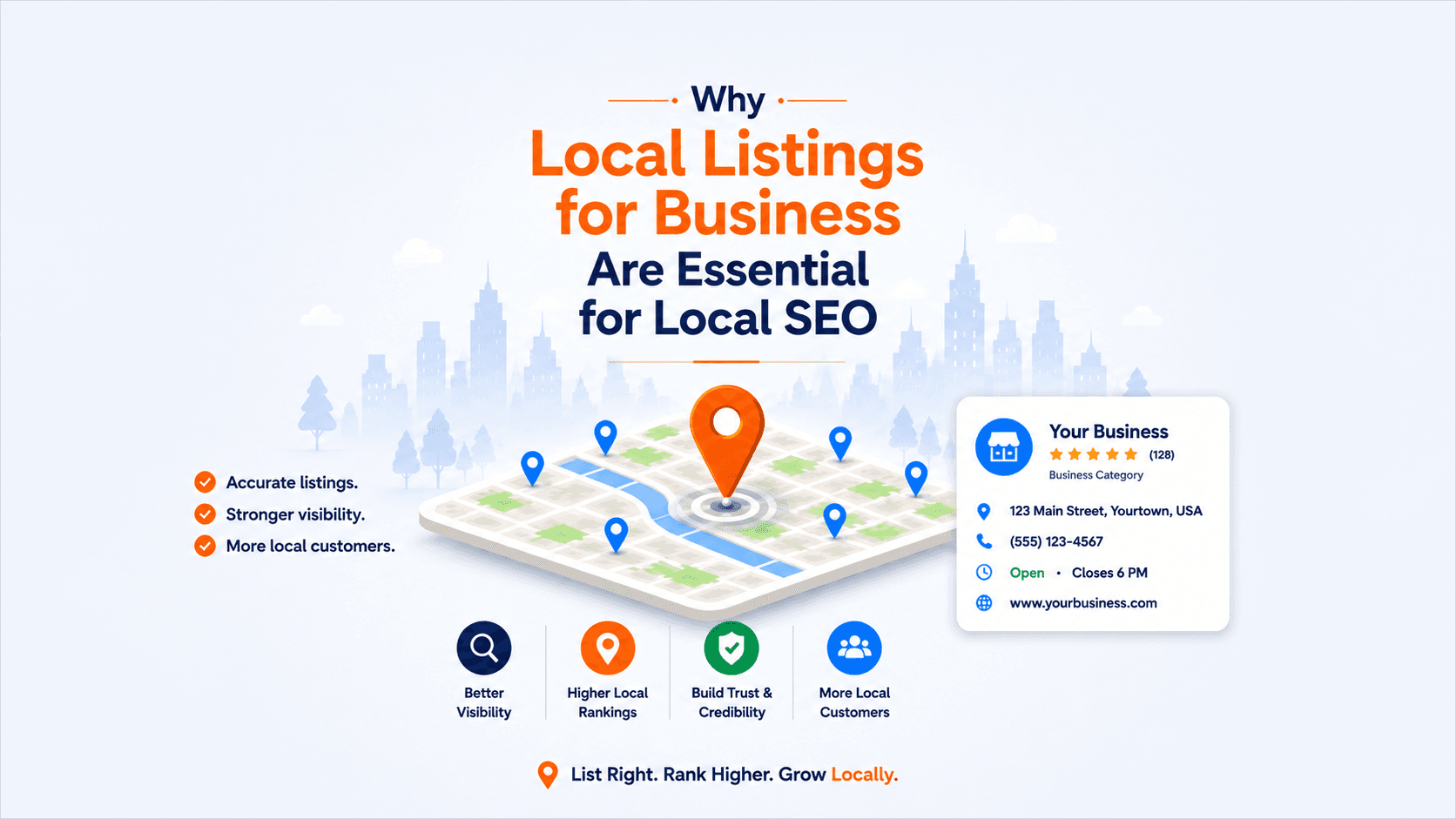 Local Business Listings
Business local listings are often the first thing a potential customer sees about your company, before they ever walk through your door or pick up the phone. Not through your website, usually. Through a listing. A quick snapshot showing your name, address, phone number, hours, and reviews, right there on Google Maps or a directory site.
And that snapshot matters more than most business owners realize. Data from Google shows that 76% of people who search for something nearby visit a related business within 24 hours, according to Think with Google's location search data. That's the window your listing needs to win. Not next week. Right now, in the moment a customer is deciding where to go.
What Are Business Local Listings, Really?
Think of a business local listing as your digital storefront. It's the profile that represents you across search engines, map platforms, and online directories, showing your business name, address, phone number, website, hours, category, and reviews.
Together, these profiles shape how customers, and increasingly, AI tools, understand who you are and whether you're worth choosing. It's a small amount of information doing a lot of heavy lifting.
Why They Matter the Moment Someone Searches Nearby
When a customer types a search into Google, or asks a voice assistant to find something close by, the results come straight from listing data. Get your details right, and you show up clearly, confidently, and ready to be chosen.
Get them wrong, and you either sink in the rankings or vanish from consideration completely. There's no in between. A search is a moment of intent, and an incomplete listing means missing it entirely.
How Accurate Listings Build Instant Trust
Trust online is earned in seconds, not minutes. A complete profile with real photos, current hours, and genuine reviews tells a customer everything they need to know at a glance: this business is legitimate, active, and worth their time.
An inconsistent listing does the opposite. A wrong phone number. An address that doesn't match your website. Suddenly, a customer is wondering if you're even still open, or worse, if you're real at all. A well-kept listing removes that hesitation before it has the chance to form.
Where Customers Actually Find Local Businesses Today
The way people discover local businesses has changed dramatically. Search engines, map apps, voice assistants, and now AI chat tools all pull from the same underlying listing data to answer questions like "who's open near me" or "best plumber nearby."
That means the number of places people rely on to find you has multiplied. Every single one of them needs a complete, accurate profile to include you in the answer.
Best Practices for Keeping Your Listings in Shape
None of this requires reinventing anything. It just requires consistency. Here's where to focus:
Keep your NAP identical everywhere. Your name, address, and phone number should match exactly across every platform you appear on. Even small mismatches confuse search engines and the AI models now summarizing local results.
Choose specific, accurate categories. A precise category helps algorithms match your profile to the right customer search, instead of burying you among broader, less relevant competitors.
Use real, current photos. Genuine images build far more trust than stock photography, with customers and with search algorithms alike.
Respond to reviews consistently. Reviews are one of the strongest trust signals tied to any listing, and responding shows customers you're actually paying attention.
Update details the moment anything changes. Hours, services, contact information: correct them everywhere as soon as something shifts, not weeks later.
Business Local Listings and the Rise of AI Powered Search
Search is evolving fast. AI overviews, chatbots, and voice assistants increasingly answer local questions directly, with no click-through to a website at all. Staying visible through that shift means your listings need clean, structured data, natural-language descriptions, and consistently up-to-date details. AI tools tend to favor the freshest, most verified source they can find.
Common Mistakes That Quietly Undermine Your Listings
Even well-meaning businesses fall into the same traps. Inconsistent details across platforms, half-finished profiles, duplicate entries, and generic descriptions copied everywhere without a second thought. Each one chips away at your visibility, making it harder for customers and algorithms alike to trust what they're seeing.
Final Thoughts
This isn't flashy work. But maintaining accurate, complete business local listings is some of the highest-leverage effort a local business can put in. Start simple: consistent details, complete profiles, real photos, and regular upkeep.
Platforms like Locato make this easier, giving your business a clear, verified home where customers can find accurate information in one place, right alongside the other directories rounding out your presence.
Somewhere right now, someone is searching nearby for exactly what you offer. Whether they find you and trust you often comes down to nothing more than getting these details right.
Frequently Asked Questions
1. What are business local listings, exactly?

Business local listings are the digital profiles, on Google, Maps, and directory sites. This display your business name, address, phone number, hours, and reviews to people searching nearby.
2. How often should I update my listings?
Anytime your hours, contact details, or services change. A regular audit every few months also helps catch small inconsistencies before customers spot them first.
3. Do local listings actually affect AI search results?
Yes. AI tools pull from the same structured listing data used by traditional search engines, so accurate, complete profiles directly influence whether an AI assistant recommends you.
4. What is NAP consistency and why does it matter so much?
NAP stands for name, address, and phone number. Keeping these identical across every platform prevents confusion for both customers and the algorithms trying to verify you're a real, trustworthy business.
5. Can duplicate listings hurt my business?
Yes. Duplicate profiles split your reviews, confuse search engines about which listing is accurate, and often display outdated information that undermines customer trust.
6. Do customer reviews really influence local search rankings?
Absolutely. Reviews are one of the strongest trust and ranking signals tied to a listing. Businesses that respond to reviews regularly tend to build even stronger visibility over time.
7. Which platforms matter most for local listings?
Google Business Profile and Google Maps carry the most weight. But directory sites, Apple Maps, Bing Places, and niche industry directories all contribute to how visible and trustworthy you appear.
8. What happens if my business information is outdated?
Outdated details, like old hours or a disconnected phone number, cause customers to lose trust instantly and often push them straight to a competitor with more reliable information.
9. How do I know if my listings are consistent across platforms?
A manual search across Google, Maps, and major directories works for a quick check, but most businesses benefit from a listings management tool that audits and updates everything from a single dashboard.
10. Is it worth using a platform like Locato to manage listings?
Yes, especially if you're managing multiple locations or don't have time for manual audits. A dedicated platform keeps your details consistent everywhere and gives customers one verified, accurate source to trust.